The Court of Florence Order, June 3, 2020: Full Text and Provenance
The order of the Tribunale di Firenze in case R.G. 2756/2020, in English translation, hosted in full. This is the ruling that rejected the official system’s copyright claim over Human Design as a set of ideas and methods.
What it is
- Document: Ordinanza (order at first hearing), Tribunale di Firenze, Sezione specializzata in materia di impresa
- Docket: R.G. n. 2756/2020; cronologico n. 944/2020
- Date: June 3, 2020; heard in written form under art. 83/7-h of decree-law 18/2020
- Judge: dott. Niccolò Calvani
- Parties: Nicolas Caposiena and Human Design Italia S.n.c., plaintiffs, against AAM Terra Nuova S.r.l., publisher of the Italian edition of Chetan Parkyn’s Human Design
- Language: English translation of the Italian original
Provenance
The order is a public act of an Italian court. The English translation hosted here is the one cited throughout The Voice on Ibiza and ZENO. It was supplied to the author by Marga Jee, who wrote the first community report of the ruling for Osho News on July 19, 2020, and it is the same rendering the passages in that report are drawn from. It runs complete, from the claimants’ recitals through both reasoned sections to the disposition and the judge’s signature. It is published here so that readers can check the citations against the document itself.
Two limits belong with it. The translation names no translator, and this archive does not know who produced it. And because the Osho News passages come from this same translation, that report corroborates that the text was in circulation within seven weeks of the ruling but is not an independent check on its accuracy. Only the Italian original can supply that check.
The Italian original is held by the issuing court, the Tribunale di Firenze, Sezione specializzata in materia di impresa, under R.G. 2756/2020. Italian civil orders are obtained from the court’s own registry rather than from an open web database, and this archive holds no copy of the Italian text; searches of the Italian business-court repositories and the case reporting found no published copy of it. The order is a public act, and both contemporaneous reports gave a route to it. Reporting the ruling on July 19, 2020, Osho News stated that a copy of the court order, “which is a public document,” could be had in Italian and English on request, and gave a contact address for it. The MCHA.nl report of the following day carried the same address. Both statements date from 2020, and this archive has not established whether the offer still stands. The address is not reproduced here; it appears in the Osho News report linked below, alongside the rest of what the open record carries. The docket citation and the translated passages can be checked against that record independently of this page.
- The docket citation and translated passages, quoted in the Legal Controversy over Copyright section of “Human Design,” Wikipedia archived . Because that article is edited continuously, the citation here is to the revision of July 10, 2026, which is fixed and cannot be altered.
- “Human Design goes to Court,” Osho News, July 19, 2020 archived , the first community report of the ruling
- “Human Design Goes to Court,” MCHA.nl, July 20, 2020, now offline and preserved at the Internet Archive
The key passages
From section (1) of the order, in the hosted translation:
The claim “does not have a probable cause”; “no evidence has been provided by the claimants to prove that they had exclusive rights on the ‘Human Design System’ or its teachings”; those teachings “cover ideas, procedures, methodologies of representation that can be freely talked about, mentioned and illustrated even by those who are not the creators.”
On the chain of title:
“If Krakower cannot be the holder of a general intellectual property right on his ideas (rather than on his works), he cannot have sold it to third parties”; “the object of the transfer cannot be the right to exploit copyright that does not exist.”
And on the limit of what remains protected:
At best the company “could sell those rights on those works, but neither it nor its assignees could prevent others from publishing other works on the ‘Human Design System’”; “neither the Design and Human Design System nor the Krakower doctrine, let alone the name Ra Uru Hu, are protected by copyright in themselves, while the ‘forms in which they are divulged’ certainly are.”
Fair-report note: the passages above are quoted for what the legal argument requires and no more. Specific copyrighted works, recordings, books, and software, remain protected; the order concerns the system as a set of ideas and methods.
How much the order decides
This is an ordinanza, an order issued at the first hearing of an expedited intellectual-property action, not a judgment after full trial. Its findings are made on the papers and to the standard of probable cause: the court held that the claim “does not have a probable cause,” which is a finding that the claimants failed to make their case out on the evidence they brought, not a declaration that no such evidence could exist. It rejected the claim and condemned the claimants, jointly and severally, to refund the defendant’s costs, assessed at 6,750 euros in professional fees plus general expenses. Italy is a civil-law jurisdiction, and the order sets no binding precedent even domestically.
Understating what the order does costs this archive nothing. Overstating it hands the other side the only rebuttal it needs.
The line about “cult-like behaviors”
One clause from section (1) travels further than the rest of the order, and it is the one most often quoted without its sentence. In the translation hosted here it reads: “nor, to do so, does one need to be authorized by a school or by its founders, since in our legal system the representation of ideas is free and is not subjected to cult-like behaviors.”
It is not a finding about Human Design, its founder, or its schools. The court heard no evidence on that question, was not asked to decide it, and did not. The clause states why the authorization the claimants said was required cannot exist under Italian law: the free representation of ideas is not subordinated to a private authority entitled to grant or withhold permission.
The rendering is also contested. The Wikipedia article on Human Design gives the same words as “sectarian control.” That is the milder and probably the more literal reading, and it describes a legal relationship where “cult-like behaviors” reads as a characterization of a movement. Only the Italian settles which the court wrote, and this archive does not hold the Italian. Both ZENO and The Voice on Ibiza carry this caution; it is repeated here because this is the page a reader arrives at to check the quotation.
The document
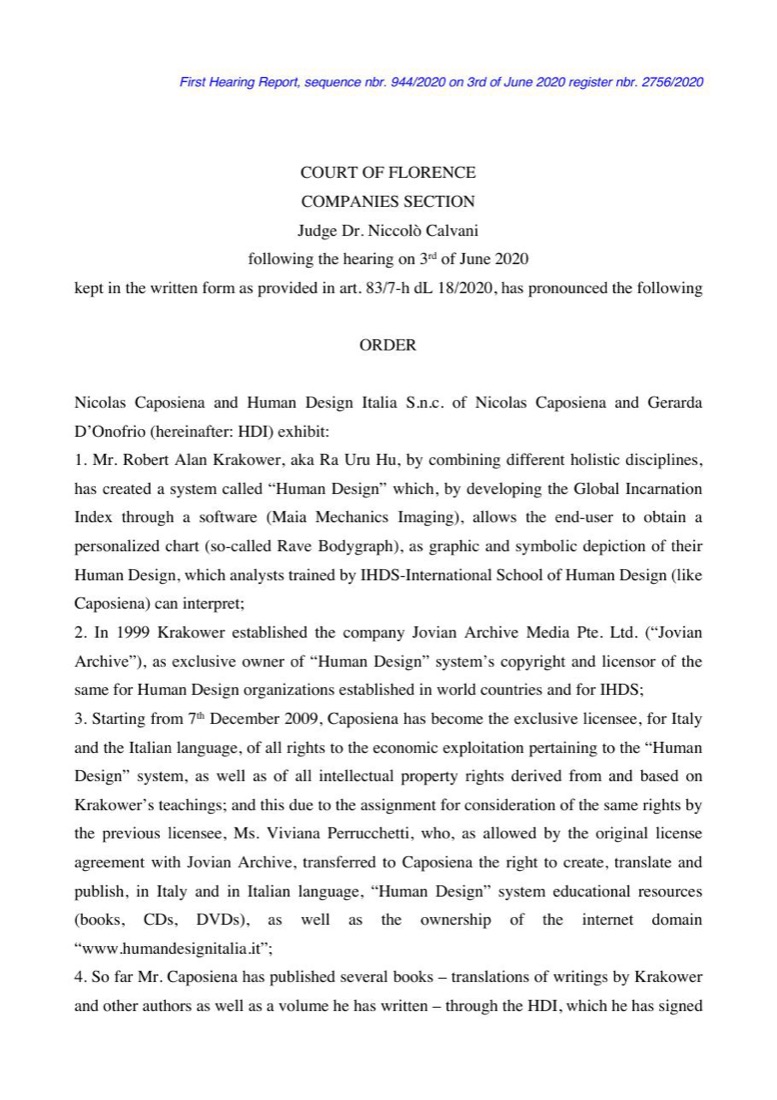
Download the PDF (English translation, about 110 KB).
What the book establishes from it
Chapter Fourteen of The Voice on Ibiza, “The Court of Florence,” reconstructs the case from this order: the licensing chain running from Jovian Archive through the Italian licensee, the September 2017 warnings, the requested withdrawal of Parkyn’s book, and the court’s holding that the system as such cannot be owned as copyright.
The companion volume ZENO treats the case in Appendix Section G and in its closing chapter, “What Remains,” where the ruling is the one occasion on which the ownership claim used against Zeno was tested by a neutral authority and failed. That book’s provenance note points here, and the docket numbers are printed there so a reader can request the order from the tribunal’s registry rather than rely on either the book or this page.
- The Florence ruling in the public record, the archive’s summary entry with secondary sources
- Can Human Design be owned?, the archive’s plain-language explainer
- Chetan Parkyn’s witness dossier, the author whose book occasioned the case